

Tips and Inspirations to Transform and Decorate Your Home with Style
Interior decoration is primarily about materials and implementation, not Pinterest palettes. Transforming a home with style requires mastering a few technical trade-offs that general guides do not address: the choice of removable coverings, consistency of finishes, and the impact of reuse on regulatory traceability. Here, we discuss the points that make the difference between a superficial makeover and a sustainable transformation.
Reuse of decorative materials and PEMD diagnosis
The reuse of old floorboards, doors, or sanitary fixtures salvaged from construction sites is no longer just an aesthetic gesture. For demolitions and significant renovations exceeding 1,000 m² of cumulative surface area, the PEMD diagnosis (products, equipment, materials, and waste) must list each item before the work begins, and then be subject to a reconciliation.
This requirement changes the game for anyone wishing to incorporate old materials into their interior decoration. A reclaimed oak floor or an Art Deco glass door must be documented: origin, condition, any treatment. Without this traceability, resale or reuse becomes legally fragile.
The REP sector for construction products and materials (PMCB), governed by the decree of June 10, 2022, provides for a progression of reuse objectives. We recommend prioritizing removable and reusable elements over glued materials or those embedded in complex structures that are difficult to dismantle. This choice steers decoration towards solutions that are screwed, interlocked, or dry-laid, which also facilitate future layout modifications.
Several resources compile feedback on these topics, notably the blog-vip.net home site which gathers practical approaches around the home and its transformations.
Drenching and saturated color: implementation technique
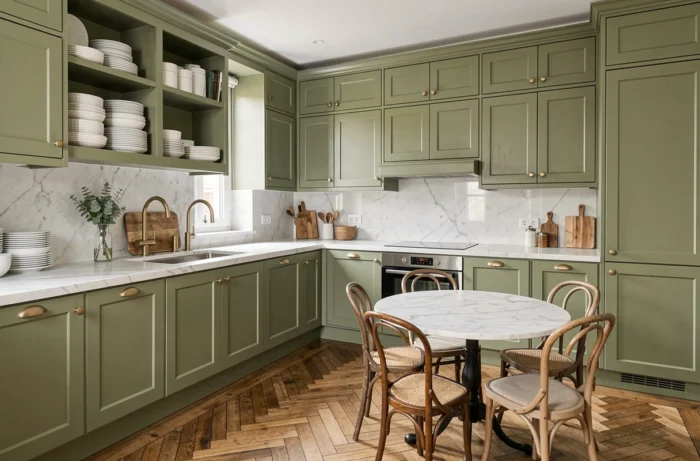
Drenching involves applying the same saturated shade on the walls, ceiling, woodwork, and sometimes the floor of a room. The desired effect is total chromatic immersion, in contrast to the single accent wall that most decor articles still recommend.
Drenching works in rooms of modest proportions, where uniform saturation eliminates visual breaks and enlarges the perception of volume. In a large open living room, the result can, on the contrary, overwhelm the space.
Preparing surfaces for a uniform finish
The technical difficulty of drenching lies in the continuity of shade between surfaces of different natures. A plaster wall, a gypsum board ceiling, and pine woodwork do not react the same way to the same can of paint. Porosity, texture, and the undercoat alter the perceived color.
We observe that using a universal blocking primer on all surfaces before applying the finish remains the most reliable method. Without this step, woodwork often turns a slightly warmer tone than the adjacent wall, breaking the immersion effect.
- Apply an identical primer on all surfaces (wall, ceiling, woodwork) to standardize absorption
- Choose a single velvet or satin finish rather than mixing matte on the ceiling and satin on the walls
- Create a full-scale sample on each type of surface before ordering the total volume
- Plan for a slightly lighter shade for the ceiling if the ceiling height is less than 2.40 m
Living room layout: circulation and furniture hierarchy
Circulation in a living room is dimensioned before choosing the sofa. Too many decor projects start from the main piece of furniture and then constrain the pathways. The result: cluttered spaces where decoration does not compensate for functional discomfort.
We recommend marking the main circulation axes on the floor (entry to kitchen, access to terrace, passage to hallway) with masking tape before placing anything. A comfortable passage requires at least 80 cm of free width. This physical marking avoids errors in digital plans, where the scale often misleads.
Hierarchy of furniture and proportions
A coherent living room relies on an anchor piece of furniture (sofa or large table), a secondary piece (armchair, bookshelf), and accent elements (side table, floor lamp). Mixing three pieces of equivalent size in the same space creates a waiting room impression, not a decorated interior.
The size ratio between the main seating and the coffee table deserves attention. The coffee table should not exceed the height of the sofa seat by more than a few centimeters, and its length should be between half and two-thirds of the length of the sofa. These proportions are not about style: they condition daily comfort of use.
Fast decor and obsolescence of decorative objects
The decoration market follows a logic of rapid renewal. Low-cost brands multiply capsule collections, and the turnover of decorative objects now matches the pace of textile fashion. The visible result in many interiors: accumulations of outdated accessories within a few months, often made from materials that are difficult to recycle.
Investing in durable storage or furnishing pieces (solid wood, metal, ceramic) and reserving seasonal renewal for washable textiles (cushions, throws, curtains) constitutes a more coherent strategy. Textiles can be replaced at a lower cost, stored easily, and given away or recycled without difficulty.
- Furniture framework in durable materials: wood, steel, stone
- Seasonal rotation limited to cushion covers, throws, and curtains
- Stable wall decoration (frames, mirrors) complemented by removable elements (interchangeable posters in a fixed frame)
This approach reduces waste volumes while allowing for refreshing the ambiance of a room without heavy intervention. A well-structured interior transforms with three cushion covers and a throw, not with a new TV unit.