

How Much Does a Fridge Weigh on Average, and How Can You Move It Easily?
A standard fridge-freezer weighs between 60 and 85 kg when empty. That figure rises above 100 kg for an American-style side-by-side model and drops below 35 kg for a mini fridge. Before moving house or simply rearranging your kitchen, this information determines how many people you’ll need, what equipment to bring and what type of vehicle to use.
The gross weight listed on the spec sheet doesn’t tell the whole story: the layout of your home, the stairs and the width of the doorways matter just as much as the kilos shown on the rating plate.
Fridge weight and home access constraints: what the spec sheet doesn’t tell you
The rating plate, located at the back of the appliance or inside the door, shows its net weight. This figure is for an empty fridge, without packaging. It doesn’t account for any food left inside or vegetable drawers filled with defrost water that you may have forgotten to empty.
A 70 kg family-size fridge-freezer is manageable for two people on a flat surface. The same load becomes a problem as soon as there’s a narrow staircase or a landing with a sharp turn. Each step requires you to shift your grip, briefly concentrating the weight on just one person. For loads over 25 kg per person, the NF X35-109 standard recommends using a hand truck or lifting straps.
So, to find out how much a fridge weighs on average, you need to consider the manufacturer’s stated weight alongside the actual conditions along the route: floors without a lift, doorways less than 70 cm wide and tight turns in hallways. A 120 kg American-style fridge that fits in a service lift presents a very different challenge from a 65 kg fridge-freezer that has to be carried up a spiral staircase.
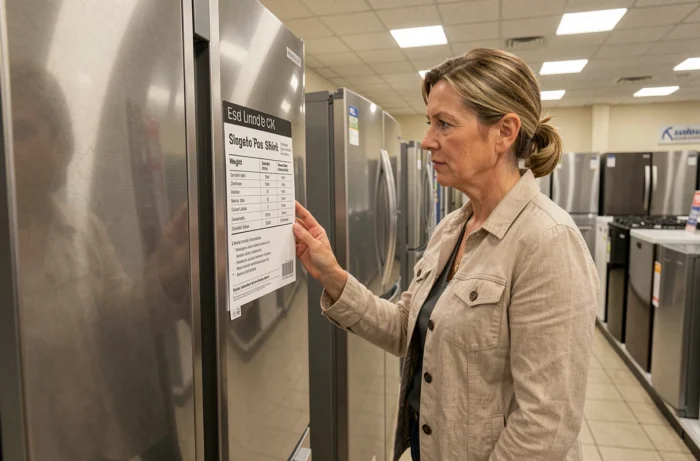
Weight ranges by refrigerator type
There are considerable differences between categories. A mini fridge weighs between 25 and 35 kg, making it manageable for one strong person. A single-door refrigerator weighs between 40 and 60 kg, at which point two people are generally needed.
Two-door fridge-freezers (refrigerator + freezer) make up the bulk of installed appliances in France. Their weight ranges from 60 to 85 kg, depending on capacity in litres, insulation thickness and whether they have a water or ice dispenser. American-style side-by-side models regularly exceed 100 to 170 kg, making them impossible to move without equipment.
Why two fridges with the same capacity can weigh different amounts
Insulation plays a direct role. An appliance rated A or B for energy efficiency often has heavier vacuum insulation panels than standard polyurethane foam. Finishes also matter: a brushed stainless-steel front adds several kilos compared with a painted sheet-metal finish.
Internal features (tempered-glass shelves, humidity-controlled drawers and an inverter compressor) add weight without changing the capacity. Two 300-litre fridge-freezers can differ by 10 to 15 kg on the scales.
Transporting a refrigerator upright: what happens inside the cooling system
The rule about transporting a fridge upright isn’t excessive caution. The compressor, located at the bottom of the appliance, contains lubricating oil. If the fridge is tilted more than 45 degrees, this oil can flow into the high-pressure circuit and reach the condenser. It can then obstruct the refrigerant flow and cause failures that are sometimes irreversible.
A refrigerator transported on its side needs to rest for 12 to 24 hours before being plugged in, giving the oil time to flow back into the compressor. If transported upright, this waiting time drops to a few hours. That difference matters when perishable food is waiting in a cooler.
Preparing the fridge before moving it out of the kitchen
- Empty the appliance completely 48 hours beforehand, including the bins, drawers and removable shelves, which should be packed separately to prevent breakage
- Unplug it and leave the doors open to defrost for 24 hours, then clean the interior walls and dry them to prevent mould during transport
- Secure the doors with wide adhesive tape or short straps, and protect the corners with blankets or corrugated cardboard
A poorly prepared fridge may leak defrost water into the vehicle, and its doors could hit door frames or become warped by vibrations if left open.
Moving a heavy fridge: hand trucks, straps and stairs
For an appliance weighing more than 60 kg, a moving hand truck is the most suitable tool. It transfers the load onto the wheels and takes the strain off the mover’s back. Models with built-in straps keep the fridge firmly against the frame when going up or down stairs.
- Tip the fridge slightly backwards (never more than 45 degrees) to position it on the hand truck’s platform
- Use lifting straps if the hand truck won’t fit through a narrow hallway, with at least two people sharing the load
- Protect floors with furniture sliders or an old folded rug under the appliance so you can slide it without scratching hardwood or tile
- In a vehicle, place the fridge upright against a wall, with the door facing the wall, and secure it to the anchor points so it won’t tip over when braking
An unsecured 80 kg fridge becomes a projectile when braking suddenly at 50 km/h. Securing it is essential.
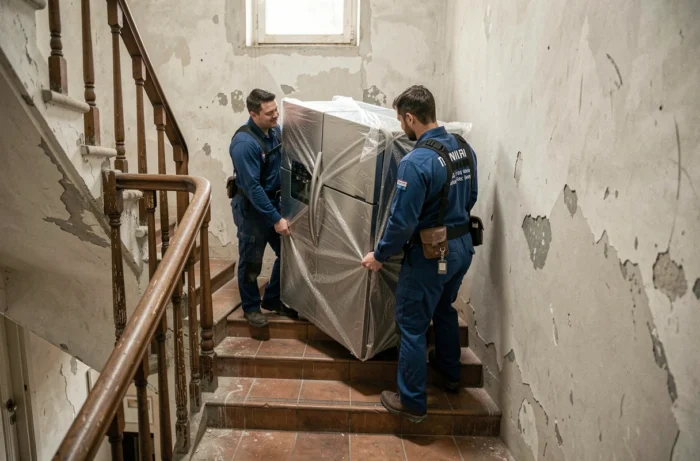
Delivery to your kitchen: when to leave it to the professionals
If you live above the second floor in a building without a lift and have an appliance weighing more than 70 kg, professional delivery is the safer option. Most retailers offer delivery upstairs and installation, which includes removing the packaging, positioning the appliance in the kitchen and sometimes taking away the old one.
This service costs extra, usually a few dozen euros, but helps prevent back injuries and damage to the appliance or your home. Replacing a compressor damaged by an impact costs more than the delivery itself.
Plugging it back in after transport: waiting times to observe
The waiting time before plugging the fridge back in depends entirely on the position it was kept in during transport. If it remained upright, you can switch it back on after waiting a few hours. If it was tilted more than 45 degrees or laid on its side, allow at least 12 to 24 hours.
Once it’s plugged in, set the thermostat to 4 °C for the refrigerator compartment and -18 °C for the freezer. The appliance needs four to six hours to reach its set temperature. Putting food away before the temperature has stabilised puts extra strain on the compressor and increases energy consumption during the first few days.
A fridge’s weight determines the equipment and number of people needed, but the route between your current kitchen and the new one is what decides whether to move it yourself or hire professionals. Measuring doorways, counting steps and checking for a lift should always be your first steps before lifting anything.