
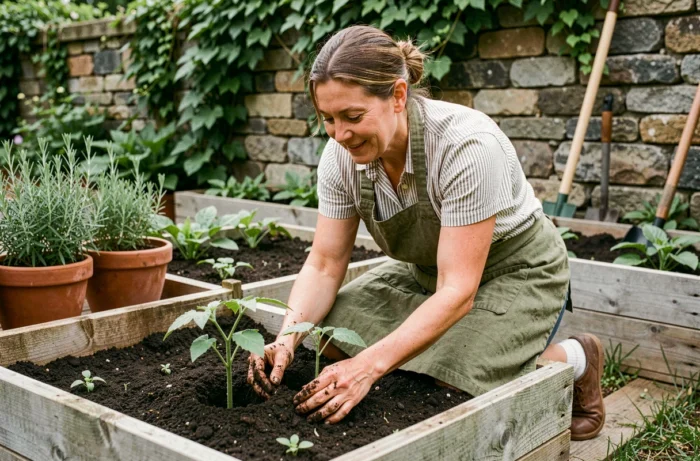
Tips and advice for successfully growing your vegetable garden and beautifying your garden all year round
Your tomatoes produced generously in August, then the vegetable garden turned into a wasteland by October. This scenario repeats every year in many gardens, due to a lack of an appropriate planting calendar and a few simple actions applied at the right time. Successfully maintaining a vegetable garden and keeping a pleasant garden year-round relies less on the time spent than on the quality of choices: what to plant, where, and how to maintain the soil between harvests.
Living soil in the vegetable garden: the foundation that fertilizers cannot replace
You may have noticed that some plots yield vigorous vegetables without any special input, while others stagnate despite fertilizers? The difference often lies in the biological life of the soil.
A soil rich in earthworms, mycorrhizal fungi, and bacteria decomposes organic matter and makes it available for the roots. Adding a chemical fertilizer nourishes the plant, but not the soil. Over time, the earth becomes compacted and retains less water.
The most effective action is to permanently cover the soil with organic mulch. Dead leaves, dried grass clippings, straw, wood chips: these materials decompose slowly and feed the soil fauna. Between two crops, sow a green manure (phacelia, mustard, clover) to prevent the soil from remaining bare and compacting under the rain.
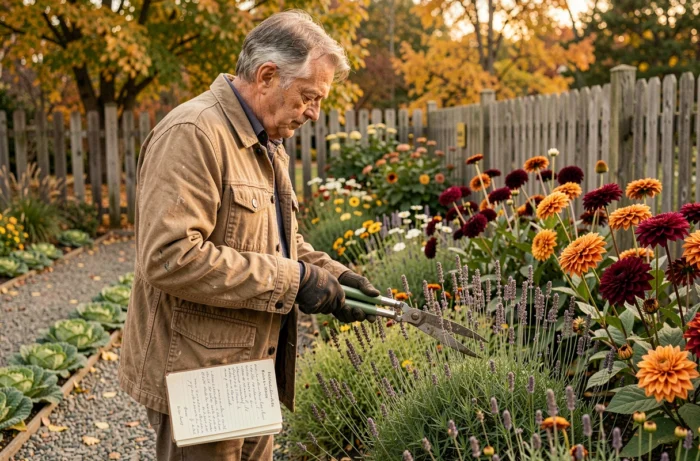
As Dédé in his garden reminds us, observing the texture of your soil throughout the seasons helps to adjust your inputs rather than following ready-made recipes.
If your soil is clayey, spread a thick layer of compost on the surface every autumn. The worms will do the incorporation work during the winter. Never till clay soil with a rototiller: deep digging destroys the structure that the microfauna has taken months to build. A simple aeration with a broadfork is sufficient.
Vegetable garden all year round: pairing vegetables by growing slots
Most competitors advise planting in spring and protecting in winter. This approach leaves the vegetable garden unproductive for half the year. Thinking in terms of growing slots changes the game.
Warm slots and cool slots
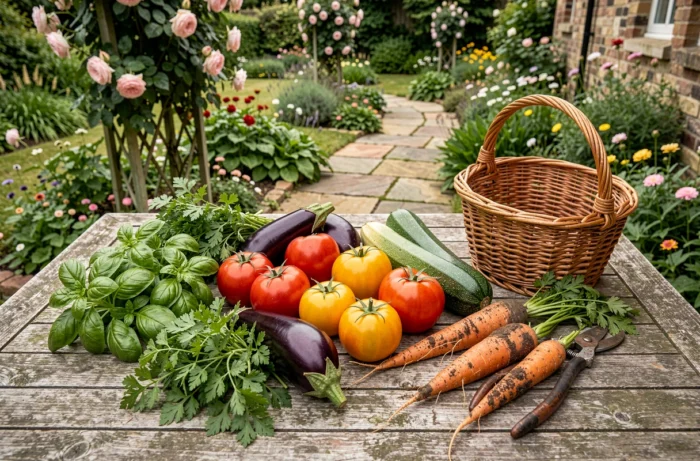
Divide your beds into two categories. The warm slots (May to September) host tomatoes, zucchini, beans, and peppers. The cool slots (October to April) are suitable for spinach, lamb’s lettuce, leeks, fava beans, and cabbages.
The same location can produce two harvests per year if you alternate a warm slot vegetable with a cool slot vegetable. After harvesting your beans at the end of August, sow lamb’s lettuce or winter radishes directly in the same bed.
Rotation and botanical families
Alternating vegetable families from year to year limits soil depletion and the proliferation of diseases. Specifically, do not plant tomatoes (solanaceae) in the same spot two years in a row. Follow them with legumes (fava beans, peas) that fix atmospheric nitrogen in the soil.
- Year 1: solanaceae (tomatoes, peppers, eggplants) followed by spinach in the cool slot
- Year 2: legumes (fava beans, beans, peas) that enrich the soil with nitrogen
- Year 3: cucurbits or greedy leafy vegetables (squashes, cabbages) that benefit from the nitrogen left by the legumes
This three-year rotation is a minimum. It works even on small areas.
Useful flowers and shrubs to beautify the garden without extra work
Beautifying a garden year-round does not mean multiplying annual flower beds to replant every spring. Perennials and shrubs with staggered flowering require much less maintenance.
Plant perennials with staggered flowering to cover each season. Hellebores bloom in winter, perennial geraniums in spring, echinaceas in summer, asters in autumn. A bed made up of four or five well-chosen perennials remains in bloom without replanting.
In the vegetable garden, certain flowers play a direct role in the health of the crops. Marigolds, planted at the base of tomatoes, repel soil nematodes. Borage attracts pollinators and improves the setting of zucchinis.
Edible hedges and small fruit shrubs
Rather than a hedge of thujas, consider a mixed hedge combining currant bushes, blackcurrant bushes, hazelnuts, and elderberry. You get a living, productive fence that is beneficial to biodiversity. An edible hedge advantageously replaces a monotonous ornamental hedge.
These small fruit shrubs require light pruning at the end of winter and little watering once established. Their deciduous foliage allows winter light to reach the vegetable garden behind.
Garden maintenance without chemicals: what the law has mandated since 2019
Since January 1, 2019, the Labbé law prohibits individuals from buying, using, or holding synthesized phytopharmaceutical products for the garden. Gone are the glyphosate containers at the back of the garage.
Only the following are still allowed:
- Biocontrol products, based on living organisms or natural substances
- Base substances labeled “Authorized for use in the garden” (EAJ), such as acetic acid and pelargonic acid
- Natural preparations with low concern (nettle, comfrey manures)
Beware of white vinegar: its use as a weed killer is not automatically legal. It must be sold and labeled as a base substance to comply with regulations. Pouring household vinegar on a path to weed it may fall under the law if the product is not approved for this use.
Mulching remains the most effective and least burdensome weed control. A layer of ten centimeters of wood chips on the paths of the vegetable garden prevents the germination of weeds without any products, while gradually enriching the soil.
Adapting your garden to this regulation is not an artificial constraint. Gardens maintained without chemicals develop functional biodiversity (ground beetles, hedgehogs, lacewings) that naturally regulates pests. The first winter without treatment may seem difficult, but by the second year, the biological balance settles in and maintenance decreases.