
How Sport Becomes a Driver of Solidarity and Social Inclusion
A football match in a priority neighborhood, a wheelchair basketball session, a boxing class for young people distanced from employment: these situations are far from anecdotal. When sport is conceived as a support tool, it produces tangible effects on the lives of participants. Understanding how it becomes a driver of solidarity and social inclusion requires looking beyond the discourse on sporting values to see what happens on the ground.
Physical Activity Referent in Medical-Social Establishments: A Structural Shift
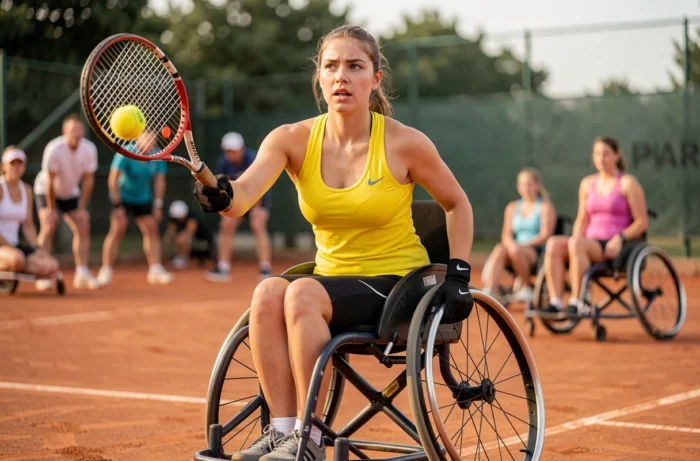
Insertion sports policies most often target clubs and popular neighborhoods. Recently, medical-social establishments (homes, medical-educational institutes, reception centers for disabled children) have also entered the scope.
Sustainable funding is being mobilized by regional health agencies to develop physical activity in these structures. The National Disability Conference 2026 plans for each medical-social establishment to have a physical and sports activity referent. This referent is a trained person who adapts sessions to the abilities of each resident, not a gym coach.
Why bring sport directly into these establishments? Access to a traditional club remains fraught with obstacles for many disabled individuals: transportation, cost, lack of suitable time slots, and the gaze of others. Offering physical activity in the living environment removes some of these barriers. Sports inclusion no longer solely depends on the goodwill of a local club.
Some local authorities are beginning to organize shared sports sessions, where disabled individuals and other groups practice together. These regular meetings, rooted in community life, change perceptions of disability as much as they improve the physical condition of participants. The association Sports Solidarité helps connect sports actors and social structures around such initiatives.
Foundation for Youth Insertion through Sport: A Bridge to Employment
Using sport as a social link is a common idea. Using it as a lever for employment policy is more recent. In 2026, the CNOSF, France Travail, and MEDEF launched the Foundation for Youth Insertion through Sport, with a specific goal: to support 100,000 young people towards employment or a qualifying training by 2030.
The initiative operates on two axes. First axis: professionalizing sports clubs to make them spaces for socio-professional support. A football or rugby club no longer just trains. It identifies young people in difficulty, provides a framework, and directs them towards training.
Second axis: creating bridges with local businesses. Punctuality, teamwork, stress management, respect for instructions. A young person involved in a sports association develops these skills, which interest employers. However, an intermediary is needed to make the connection. This is the role of this foundation.
What This Changes for Local Associations
For a small club in a rural area or a priority neighborhood, this structuring provides both a framework and funding. Many associations had projects for insertion through sport without official recognition or dedicated budget.
Insertion through sport becomes a measurable public policy axis, with monitoring indicators and quantified objectives. This shift from a logic of testimonies to a logic of results also transforms the role of the sports educator. Their role is no longer limited to animation: they fully participate in social support.
Measuring Sports Inclusion for Disabled Individuals: The Data Challenge
Claiming that sport promotes the inclusion of people with disabilities is not enough. Proving it with reliable data is another matter. This is precisely the goal of the shift initiated in 2026.
The National Disability Conference plans to create a sports disability component within the National Sports Observatory and the platform data.sport.gouv.fr. The reasoning is straightforward: we cannot improve what we do not measure. How many disabled individuals practice a sport in a club? What obstacles are most frequently encountered? Which disciplines have the best reception rates?
Today, these questions lack reliable statistical answers. Data remains fragmented, collected heterogeneously by federations. A national measurement tool will allow:
- Identifying areas where adapted sports offerings are lacking, to direct public funding to the areas that need it most
- Comparing practices between federations and identifying those that are genuinely progressing in terms of inclusive reception
- Tracking year-on-year evolution, moving from isolated initiatives to data-driven management
This dynamic aims to integrate the reception of disabled individuals into the regular functioning of sports federations, no longer as a separate project, but as a normal component of their activity.
Pass’Sport and Financial Access: A Safety Net for Low-Income Families
The cost of a license remains a major barrier for the most modest families. Sports inclusion is not limited to disability or employment. It also involves financial considerations.
The Pass’Sport targets young people under 18 whose families receive certain allowances. The aid does not cover the entire registration fee, let alone equipment. It acts as a trigger: by sufficiently reducing the financial barrier, it allows hesitant families to take the plunge. Local associations complement the system by lending equipment or organizing solidarity sales.
Sport as a driver of solidarity and social inclusion does not rely on a single mechanism. It is the interplay between Pass’Sport, committed clubs, foundations dedicated to insertion, and rigorous measurement of results that produces lasting effects. The tools exist. Their networking at the local level remains the most concrete challenge of the coming years.