
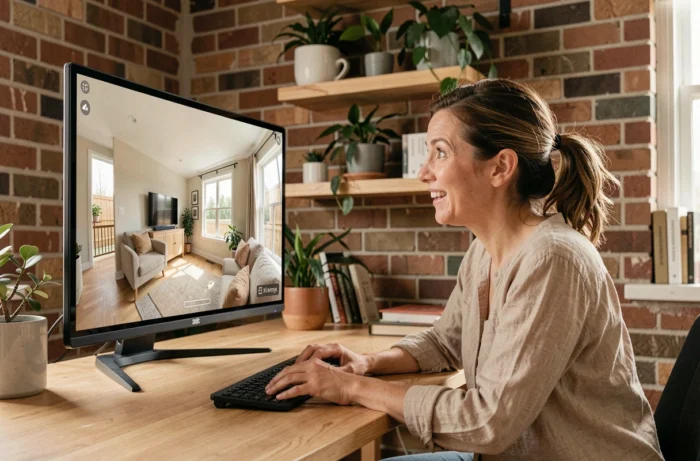
360 Virtual Tour: The New Asset to Trigger Real Estate Love at First Sight
The 360 virtual tour is not just an interactive slideshow. It is a navigable model that engages the responsibility of the professional regarding the fidelity of the representation, the protection of the personal data of the occupants, and the accessibility of the interface. We note that most articles on the subject limit themselves to marketing benefits, ignoring the technical and regulatory constraints that condition the actual quality of the deliverable.
GDPR Compliance and Personal Data in a Real Estate Virtual Tour
A 360 tour captures everything contained in the property at the time of the scan. Family photos on a sideboard, visible mail on a table, nameplate at the entrance, computer screen on: all these elements constitute identifying personal data as defined by the GDPR.
We recommend a systematic protocol before each shot: removal of identifying documents, turning off screens, temporarily taking down frames containing recognizable faces. Blurring in post-production remains an option, but it degrades visual quality and does not eliminate the risk of oversight.
The duration of the online presence of the 3D model must also be contractually defined with the seller. A property sold for several months with the tour still indexed by search engines poses a proportionality issue regarding processing. According to Dipeeo, real estate professionals must obtain the necessary permissions, limit identifying elements, and define a precise duration for online presence.
An article published on lamaison360 and layout on Ventes Immo details how the preparation of the property before the scan directly contributes to the perceived quality of the tour.
Digital Accessibility of 360 Tours: What the European Accessibility Act Changes
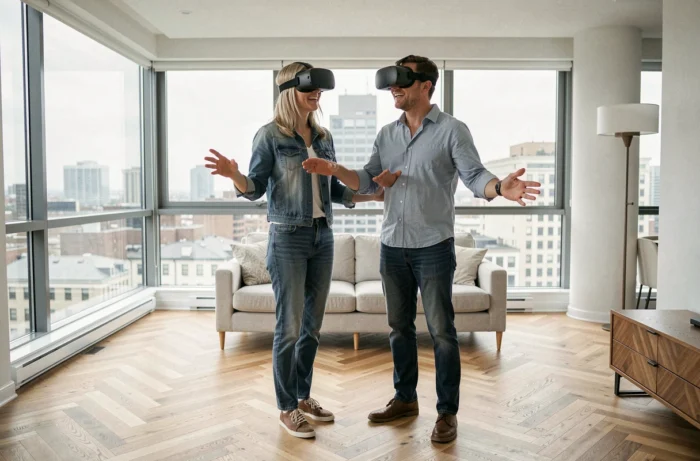
Since June 28, 2025, the European Accessibility Act, transposed in France by the law of March 9, 2023, and its implementing decree of October 9, 2023, imposes accessibility requirements on certain e-commerce services. Interfaces offering a virtual tour potentially fall within this scope.
In concrete terms, a 360 viewer must remain usable by people with disabilities. Keyboard navigation, compatibility with screen readers, alternative text descriptions of rooms: these elements are no longer bonuses but compliance criteria.
Microenterprises benefit from exemptions, but a medium-sized real estate agency that broadcasts its tours on its own site or via a third-party portal cannot hide behind this exception. We observe that the majority of virtual tour solutions on the market do not yet integrate a native accessibility layer, which shifts the burden of compliance to the user agency.
Virtual Home Staging and the Risk of Misleading Commercial Practices
Virtual home staging involves digitally furnishing an empty space in the 360 model. The tool is powerful in helping the buyer to envision the space, but excessive retouching may constitute misleading commercial practice if it alters the perception of volumes or masks structural defects.
Virtually removing a crack, widening a hallway through optical distortion, or replacing a degraded floor covering with new hardwood in the rendering: these interventions exceed staging and fall into the realm of altering information due to the buyer. The criteria to respect to remain within a fair framework:
- Explicitly mention in the listing that the property has undergone virtual home staging, indicating the affected rooms
- Do not modify either the proportions or the geometry of the spaces compared to the actual measurements from the diagnostics
- Keep an unretouched version of the scan available upon request for comparison during the physical visit
A buyer who discovers a significant discrepancy between the virtual model and reality has recourse. Transparency about the exact scope of retouching protects both the seller and the agent.
Measuring the Real Cost Per Lead of a 360 Virtual Tour
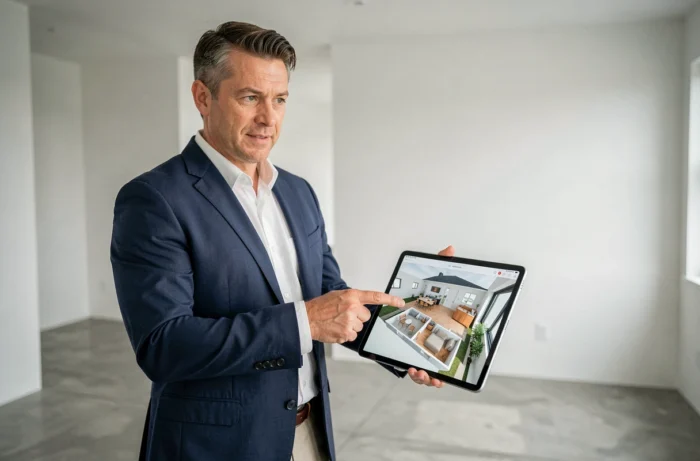
Investing in a 360 scan has a direct cost (service provider, equipment, post-production) and an indirect cost (preparation time of the property, management of online presence, hosting maintenance). The right indicator is not the price of the scan, but the cost per qualified physical visit it generates.
We recommend tracking three metrics to assess profitability:
- The conversion rate between viewing the virtual tour and requesting a physical visit, compared to the rate obtained with a classic photo listing
- The number of physical visits needed before making an offer, which should decrease if upstream filtering works
- The average time to sell the property, compared with comparable properties marketed without a 360 tour
A scan that generates many views but few qualified requests indicates either an overvalued property or a gap between the virtual promise and the perceived reality. The 360 tour is not a sales accelerator in itself: it is a filter that concentrates commercial effort on genuinely interested buyers.
Choice of Capture Equipment and Quality of Real Estate Rendering
The resolution of the sensor determines the readability of details in the viewer. Below a certain pixel density per spherical image, wall textures and floor finishes become blurry when zoomed in, which harms the credibility of the rendering.
Dual or quadruple lens wide-angle cameras produce panoramas that are automatically stitched. The quality of the stitching conditions the absence of artifacts at the joints, particularly visible on straight lines (door frames, baseboards). Poor stitching gives an impression of amateurism that detracts from the property.
Natural lighting remains the most underestimated factor in the final quality. A scan conducted on a cloudy day produces more uniform contrasts than a scan in full sunlight, which generates overexposed areas near windows and harsh shadows in recessed rooms. Planning the capture session according to the orientation of the property and the weather is part of the preparation work, just like tidying up.
The 360 virtual tour works when it is based on a rigorous protocol, from the preparation of the property to the analytical follow-up after going online. Without this framework, it remains a technological gadget that impresses at first glance but disappoints during the physical visit.