
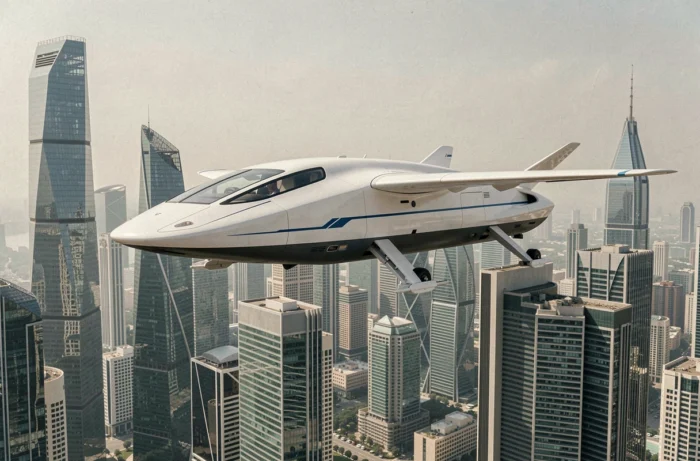
Flying shuttles are revolutionizing urban mobility and futuristic travel
Flying shuttles refer to electric aircraft with vertical take-off and landing capabilities, known as eVTOL (electric Vertical Take-Off and Landing). These devices combine the compactness of a helicopter with electric propulsion distributed across multiple rotors. Their primary purpose: to provide short connections in dense urban environments, where road traffic saturates ground infrastructure.
eVTOL Certification: Five Distinct Hurdles Before the First Commercial Flight
Most public presentations focus on the technical prowess of the device. The regulatory reality is more fragmented. The certification of the device alone is not enough to authorize a commercial service in the city.
The FAA in the United States and the EASA in Europe have structured the process around separate layers of authorization. Obtaining a type certificate for the machine (its design, structural integrity, safety systems) only covers a fraction of the journey.
Operators must then meet distinct requirements concerning:
- The continued airworthiness of each aircraft in service, with inspection cycles adapted to electric motors and batteries.
- The actual flight operations, governed by an operator certificate that defines routes, altitudes, and emergency procedures.
- The qualification of pilots, which requires specific type training for the aircraft, including hours on a simulator calibrated for the flight characteristics of an eVTOL.
- The integration into urban airspace, where emergency helicopters, delivery drones, and airport approach corridors already coexist.
This separation between technical certification and operational authorization explains why several manufacturers have a certified device without offering commercial flights. Speeder also tracks the advancements of these vehicles that are redefining urban mobility.

Ground Infrastructure of Vertiports: The Real Bottleneck
A vertiport is not just a landing platform on a building rooftop. Electrical sizing is the limiting factor that optimistic projections often overlook.
Charging needs reach the megawatt class, a scale comparable to the largest heavy vehicle charging stations. Recharging an eVTOL battery between two rotations of a few minutes requires a connection to an industrial-level electrical grid.
The issue thus shifts from the physical construction of the platform to managing power peaks. A vertiport hosting multiple rotations per hour generates simultaneous charging requests that the local distribution network is not always sized to absorb.
Land Use and Urban Planning Constraints in France
In dense urban areas, available land to establish a vertiport remains scarce. Rooftop terraces capable of supporting the static load of an eVTOL, vibrations, and passenger flows represent only a fraction of the existing real estate stock.
Noise pollution, even reduced compared to a conventional helicopter, raises acceptability questions in residential neighborhoods. Urban planning permits will need to incorporate specific noise studies, distinct from those applied to traditional heliports.
Batteries and Range: Physics Imposes Limits on Flying Shuttles
The energy density of current lithium-ion batteries remains the main technical barrier. Flying a vehicle consumes significantly more energy than driving it, at equivalent loaded mass.
Airbus has suspended the CityAirbus NextGen program because the economic calculations related to batteries did not allow for a viable business model. This case illustrates a structural point: as long as energy density does not increase significantly, eVTOLs will remain confined to short trips, typically a few dozen kilometers.
Fast charging between flights exacerbates cell aging. The faster the charge, the quicker the chemical degradation, which reduces battery lifespan and increases maintenance costs. This trade-off between commercial turnaround time and battery longevity has yet to find a satisfactory large-scale solution.
Hydrogen as an Alternative to Batteries
Some manufacturers are exploring hydrogen fuel cells to bypass the limitations of batteries. Hydrogen offers a more favorable mass energy density, which would extend range without adding weight to the device.
The challenge then shifts to the production, storage, and distribution of green hydrogen at vertiports. The hydrogen infrastructure for urban aviation remains in its infancy, even in the most advanced countries in the sector.
Sustainable Urban Mobility: What Flying Shuttles Change (and Don’t Change)
eVTOLs eliminate direct emissions during flight thanks to their electric propulsion. Zero fine particles, zero CO2 at the point of use. For air quality in cities saturated by automobile traffic, the local benefit is real.
However, the overall balance depends on the source of the consumed electricity and the carbon footprint of battery manufacturing. In France, where the electrical mix remains largely decarbonized, the environmental advantage is clearer than in countries reliant on coal.
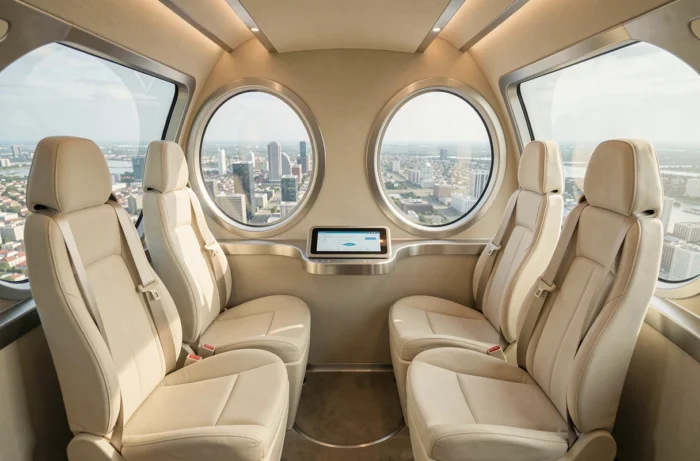
Flying shuttles will not replace mass public transport. An eVTOL carries two to six passengers. Its capacity is not comparable to that of a subway or tram. Urban air mobility targets specific corridors (airport-city connections, crossing geographically constrained areas) rather than a complete territorial network.
The global advanced air mobility market is projected to experience substantial growth in the coming years, driven by investments from aerospace manufacturers and specialized funds. The first regular commercial routes, if regulatory and technical hurdles are lifted, could appear in certain metropolitan areas before the end of the decade. The transition from a certified prototype to a functional transport network remains the longest part of the journey.