
Discover how to choose your sports equipment for optimal performance
The sports equipment market is undergoing a period of regulatory and technological change. Since the adoption of Regulation (EU) 2023/988 on general product safety (GPSR), traceability and compliance requirements are gradually being applied to sports items sold online as well as in stores. Choosing sports equipment is no longer just about comparing prices or designs: the reliability of the manufacturer, the standards met, and the suitability for actual practice weigh more heavily than before.
Traceability and compliance: what the GPSR regulation changes for sports equipment
Most buying guides focus on comfort or value for money. None address the regulatory dimension, which is changing the selection criteria for equipment.
The Regulation (EU) 2023/988, which came into effect on June 12, 2023, imposes enhanced obligations on manufacturers and distributors. Among these: providing an accessible declaration of conformity, clear instructions in the language of the country of sale, and complete product traceability. Online marketplaces are now required to remove items flagged as dangerous.
For a buyer, this translates into a simple reflex: check that the product displays a conformity reference and that the seller can provide technical documentation. Equipment sold without a mention of standards, without instructions, or by an unidentifiable reseller presents an increased risk, regardless of its attractive price.
Field reports diverge on this point: some low-cost equipment sold on generalist platforms formally complies with the framework, while others do not. The absence of regulatory marking remains the most reliable warning signal to rule out a dubious product.
To guide searches towards compliant ranges suitable for different levels of practice, the equipment offered by Sport et Form covers a wide spectrum, from weightlifting gear to cardio accessories.
Sports shoes: adapting the choice to foot biomechanics
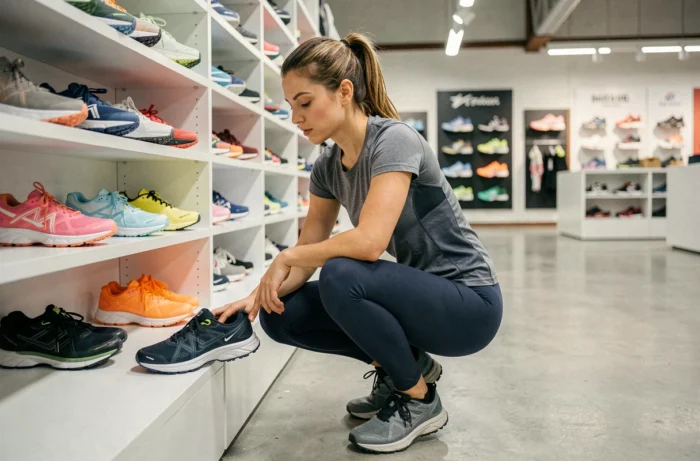
The shoe concentrates the majority of purchasing errors. Too often chosen based on aesthetic or brand criteria, it nonetheless influences posture, cushioning, and the prevention of joint injuries.
Type of stride and practice surface
A runner practicing on the road has different needs than a trail runner on technical terrain. The stride (pronated, supinated, or neutral) determines the type of support needed at the arch of the foot. Ignoring this parameter is like wearing glasses with an inappropriate prescription: the body compensates, but wear accumulates.
- Pronated stride: favor models with medial support to limit the inward collapse of the foot
- Supinated stride: look for soft, neutral cushioning, without directional correction
- Neutral stride: most standard models are suitable, but check the drop (difference in height between heel and forefoot) according to the discipline
A high drop is suitable for heel striking, while a low drop favors a midfoot strike. The available data do not allow for a conclusion that a certain type of drop systematically reduces injuries, but the mismatch between drop and running habit increases strain on the Achilles tendon.
Training frequency and lifespan
A pair used three times a week on the road loses its cushioning properties much faster than a pair used occasionally. Manufacturers rarely communicate on the actual lifespan in terms of number of sessions. However, the condition of the midsole (the layer between the outsole and the insole) remains the most concrete indicator: when it visibly compresses, replacement is necessary.
Sports clothing: thermal comfort and freedom of movement
The choice of sports clothing is based on two axes: moisture management and the absence of mechanical constraints during exertion.
Synthetic fibers (polyester, polyamide) wick away sweat more effectively than cotton, which absorbs moisture and stays wet against the skin. For outdoor practices, the three-layer system (breathable, insulating, waterproof) remains the technical reference. Each layer serves a distinct role, and removing one degrades the entire system.
The cut of the garment deserves as much attention as the material. An overly loose t-shirt creates friction during repetitive movements (running, rowing). An overly tight legging compresses the muscles and limits blood circulation during long sessions. Choosing the right size takes precedence over the choice of brand.
Protective equipment: helmets, knee pads, and standards to check
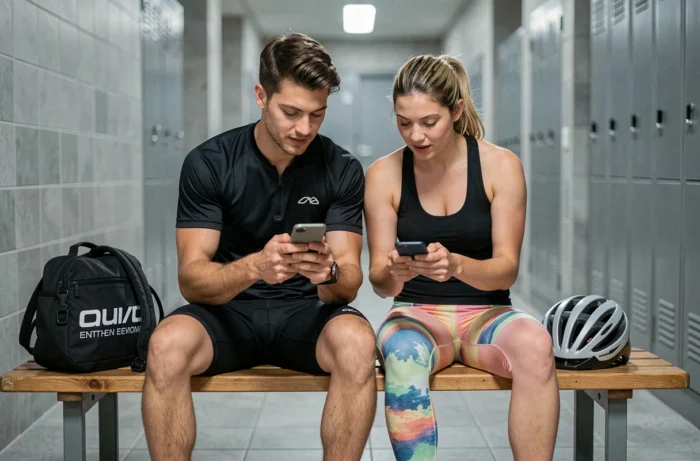
Protective equipment (bike helmets, shin guards, knee pads) falls under a stricter regulatory framework than clothing or shoes. The bike helmet, for example, must meet the EN 1078 standard in Europe to be legally marketed.
The GPSR strengthens the monitoring of these products, particularly those sold online by third-party sellers. A study reported by AFP showed that the majority of sports helmets pass European safety tests, but formal compliance does not guarantee a proper fit for the user’s morphology.
- A helmet must be adjusted without excessive tightness: it should not move laterally or compress the temples
- Knee and elbow pads must support the joint without restricting the range of motion
- Back protectors for mountain biking or skiing follow the EN 1621 standard, with distinct levels of protection depending on the intensity of practice
The reflex to adopt before any purchase of protection: identify the applicable standard for your discipline, then check its mention on the product or its packaging. Protective equipment without a regulatory reference should not be considered, even temporarily.
Weight training equipment: resistance, stability, and suitability for level
In weight training, the choice of equipment depends as much on the available space as on the program being followed. An unstable bench or poorly calibrated dumbbells increase the risk of injury much more than a poorly executed exercise.
The quality of the fittings, the maximum load capacity, and the stability on the ground are the three technical criteria to examine. A weight bench must support at least the user’s weight plus the lifted load, with a safety margin. Serious manufacturers display this data; its absence on the product sheet is a negative signal.
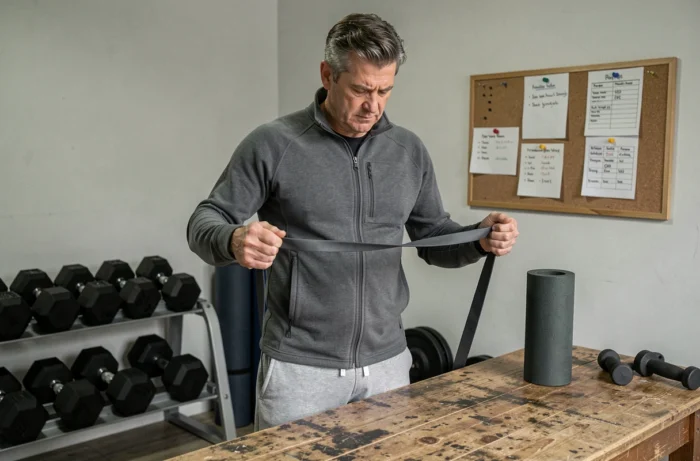
For beginners, resistance bands and kettlebells offer a progression that guided weight machines do not always allow. They engage stabilizing muscles and reduce dependence on expensive equipment.
The choice of sports equipment impacts the safety, comfort, and durability of practice. European regulatory developments push the market towards greater transparency, but the final responsibility remains with the buyer: check the standards, test the fit, and prioritize technical relevance over the displayed price.