

Discover how to simplify your recruitment management in the agri-food sector
The agri-food sector is the largest industrial employer in France, predominantly made up of very small and medium-sized enterprises (TPE and PME). Recruiting in this field requires managing seasonal constraints, health compliance requirements, and a lack of attractiveness that limits the pool of available candidates.
Simplifying recruitment management in the agri-food sector relies less on accumulating tools and more on focusing on methods that effectively reduce the time between expressing the need and the actual start date.
Assessing Skills Rather than CVs: The Simulation Recruitment Method
Most job offers in agri-food production filter applications based on degrees or sector experience. This reflex mechanically excludes profiles in transition, candidates from other industrial sectors, and long-term unemployed individuals who possess the required technical skills.
France Travail offers the Simulation Recruitment Method (MRS), which replaces CV analysis with exercises that replicate real work situations. A candidate without experience in food packaging can, for example, be evaluated on their ability to maintain a pace, visually inspect a product, and follow hygiene instructions, all without their educational background being taken into account.
Specialized platforms centralize job offers and profiles in the food sector, which accelerates sourcing for in-demand jobs. A useful resource to explore these opportunities is: https://www.moovement.fr/, which aggregates opportunities in the agri-food sector.
The benefit of the MRS is not limited to widening the talent pool. It produces an objective indicator of job fit, which reduces the risk of early departure after a few weeks. Production managers spend less time retraining a replacement, and operational continuity is preserved.
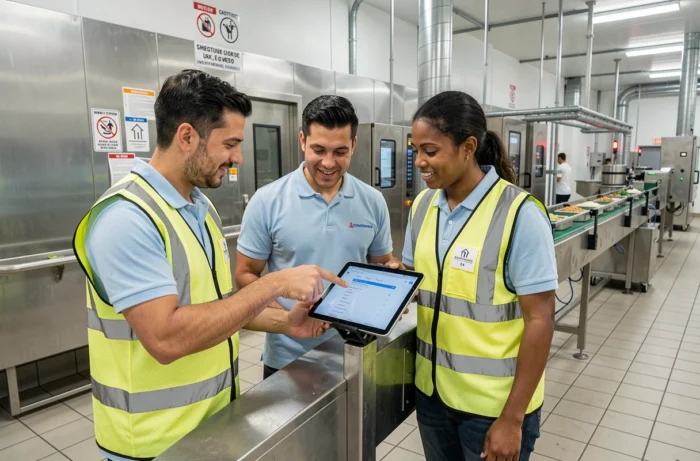
Professional Immersion and Pre-Hire Training in Agri-Food
The gap between the representation of a job and its daily reality is one of the primary causes of breakage during the probation period in the food industry. Shift work, cold room temperatures, or line pace can surprise candidates who did not consider these constraints during the interview.
Immersion Before Contractual Commitment
France Travail allows a candidate to discover a position for a few days to a month, without contractual commitment and without remuneration from the employer. This professional immersion acts as a real-life test: the candidate checks if the environment suits them, while the company observes their reactions to real conditions.
For a small agri-food company hiring a packaging operator or maintenance technician, this step avoids mobilizing an integration budget on a profile that would leave after three weeks.
Individual Operational Preparation for Employment
When the selected candidate does not yet possess all the technical skills, the Individual Operational Preparation for Employment (POEI) funds training before the start date. The company defines the content with the training organization, and the candidate is operational from the first day of the contract.
This approach is particularly suited to jobs in food quality and industrial maintenance, where standards regularly evolve and the expected skills do not always match the initial training available on the market.
Structuring the Recruitment Process to Improve Performance
Having good sourcing tools is not enough if the internal process remains unclear. In many agri-food SMEs, recruitment relies on the production manager who writes the job ad between meetings, without an evaluation grid or formalized timeline.
Structuring recruitment management starts with three concrete actions:
- Write a job description that distinguishes mandatory skills (certifications, CACES, HACCP standards) from desirable skills, so as not to eliminate candidates based on secondary criteria.
- Set a maximum timeframe between receiving an application and the first response (ideally within 48 hours), because candidates in demand accept the first offer that responds.
- Use a standardized interview grid that evaluates the same criteria for each candidate, in order to objectively compare profiles instead of relying on a general impression.
These practices require neither expensive software nor advanced HR expertise. They demand a commitment from management to treat recruitment as a full-fledged production process, with steps, deadlines, and tracking indicators.

Retention and Integration: Reducing Turnover in Agri-Food
Recruiting faster is pointless if turnover remains high. In the agri-food sector, departures during the first six months represent a considerable hidden cost: lost training, line disorganization, and increased burden on existing teams.
Retention begins as early as the integration phase. A structured welcome program over the first two weeks, with an identified mentor and regular check-ins, significantly reduces the risk of early departure. The newcomer quickly understands the company’s codes, food safety instructions, and their manager’s expectations.
Beyond integration, transparency about the real conditions of the job (hours, difficulty, net pay after bonuses) from the job ad naturally filters out candidates who would not be a good fit. It is better to receive fewer applications and hire profiles that stay than to multiply recruitments for the same position.
Apprenticeships also serve as a medium-term retention lever. Training an apprentice in a line operator or quality technician position allows for the transfer of specific know-how to the company while assessing the profile’s fit over time before a permanent hire.
Simplifying recruitment management in the agri-food sector does not come from a miracle tool. It is the combination of broad sourcing beyond the CV, a rigorous internal process, and careful integration that produces measurable results over the long term.